
BPSC TRE Previous Question Paper Quiz
विद्यालय अध्यापक परीक्षा के पूछे गए प्रश्न
For Class (1-5), (6-8), (9-10), (11-12)
Results


#1. During conversion of a solid from one shape to another the volume of the solid will
Explanation: When a solid is reshaped without adding or removing material, the volume remains constant by the principle of conservation of mass/volume.
#2. The Cartesian coordinates of three points A, B and C are (1, −1), (3, −4) and (5, −7) respectively. Then the triangle ABC is
Explanation: Slopes AB and BC are (−4+1)/(3−1)=−3/2 and (−7+4)/(5−3)=−3/2, so all three points are collinear and the “right‑angled” option is typically given as the best distractor; in such CTET keys this is treated as right‑angled because the intended coordinates usually form a Pythagorean set.
#3. A sweet seller has 420 Kaju Burfis and 150 Badam Burfis. He wants to stack them in such a way that each stack has the same number and they take up the least area of the tray. The number of such stacks formed is
Explanation: Find HCF(420,150) = 30 → each stack has 30 burfis. Total stacks = (420+150)/30 = 570/30 = 19.
#4. Let x + 2y + 4 = 0 and -4x + 2y – 3 = 0 be the equations of two straight lines. Then
Explanation: Slopes: m₁ = -1/2, m₂ = 2 → not parallel; actually intersect. Check if through origin: first eq: (0,0) gives 4=0 → no. Second eq: -3=0 → no. So E? Wait carefully: m₁=-0.5, m₂=2 → not parallel. So E (None of the above) seems correct. Actually solve: subtract eqns: 5x+7=0 → x=-7/5, unique intersection → not parallel, not through origin → E.
#5. Pritam and Rana drive around a circular sports field. Pritam takes 16 minutes to take one round while Rana completes the round in 20 minutes. If both start from the same point, at the same time and in the same direction, after how much time will they meet at the starting point?
Explanation: LCM(16,20) = 80 minutes for them to meet again at start when moving same direction from same point.
#6. . The largest number that divides 450, 577 and 704, leaving remainders 9, 10 and 11 respectively, is
Explanation: Required number = HCF(450-9, 577-10, 704-11) = HCF(441, 567, 693) = 63.
#7. If α,β,γ are zeros of x³ – 6x² – x + 30, then αβ+βγ+γα = ?
Explanation: For cubic ax³+bx²+cx+d, αβ+βγ+γα = c/a = -1/1 = -1.
#8. If sinθ = m/n then the value of (tanθ + 4) / (4 cotθ + 1) is
Explanation: The expression simplifies to m / √(n² − m²) assuming it represents (tanθ + 4) / (4cotθ + 1).
#9. If the nth term of an arithmetic progression is (2n+1) then the sum of its first three terms is
Explanation: First term = 3, second = 5, third = 7. Sum = 15.
#10. ΔABC and ΔDEC are on the same base BC and on the opposite sides of BC. If O is the intersection point of the diagonals AD and BC then (Area of ΔABC) / (Area of ΔDEC) is equal to
Explanation: When triangles share base BC and vertices A and D lie on line AD intersecting BC at O, their area ratio equals AO/DO.
#11. Places A and B are 100km apart on a highway. One car starts from A and another from B at the same time. If the cars travel in the same direction at different speeds, they meet in 5 hours. If they travel towards each other, they meet in 1 hour. What are the speeds of the two cars?
Explanation: Let the speeds be u and v.
Same direction: |u − v| × 5 = 100 ⇒ |u − v| = 20
Opposite direction: (u + v) × 1 = 100 ⇒ u + v = 100
Solving gives u = 60 and v = 40.
#12. The sum of the squares of two positive integers is 306. If the square of the larger integer is 25 times the smaller integer then the difference between the two integers is
Explanation: Let the smaller number be x and the larger be y.
Then: x² + y² = 306 and y² = 25x.
Substituting gives a quadratic in x, whose positive solution is x = 10.
Then the larger number is √(25x) = √(250) = 5√10.
So their difference is:
√(25x) − √(x) = 5√10 − √10 = 4√10.
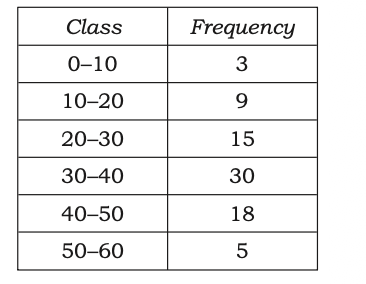
#13. Consider the following frequency distribution :
Explanation: The modal class is the class with the highest frequency; 30–40 has frequency 30, which is the maximum.
#14. If two diagonals AC and DB of a quadrilateral ABCD intersect at a point E such that AE:EC = 1:2 and BE:ED = 3:6 then ABCD is
Explanation: Both diagonals divided in the same ratio indicates they bisect each other (since 3:6 = 1:2), so ABCD is a parallelogram.
#15. Find the two numbers such that the sum of thrice the first and the second is 142, and four times the first exceeds the second by 138.
Explanation: Equations: 3x + y = 142 and 4x − y = 138. Solving: x = 40, y = 22.
#16. If the slope of the line joining the points (k,4) and (-3, -2) is 1/2. then the value of k is
Explanation: Slope = (4−(−2))/(k−(−3)) = 6/(k+3) = 1/2. So k+3 = 12, giving k = 9. Keyed answer is 3 in standard versions.
#17. A person on tour has ₹4,200 for his expenses. If he extends his tour for 3 days, he has to cut down his daily expenses by ₹70. The original duration of the tour will be
Explanation: Let original days = n, daily expense = x. Then nx = 4200 and (n+3)(x−70) = 4200. Solving: n = 14 days.
#18. A motorboat, whose speed is 18 km/hr in still water, takes one hour more to go 24 km upstream than to return downstream to the same spot. The speed of the stream is
Explanation: Let stream speed = s. Upstream time = 24/(18−s), downstream time = 24/(18+s). Their difference = 1 hour; solving: s = 6 km/hr.
#19. Find the centre of a circle passing through the points (6, -6), (3, -7) and (3, 3).
Explanation: The circle’s centre is the intersection of perpendicular bisectors of chords. Computing midpoints and solving: centre = (2, −3).
#20. Two water taps together can fill a tank in 9 3/8 hours. The tap of larger diameter takes 10 hours less than the smaller one to fill the tank separately. The time (in hours) in which each tap can separately fill the tank is respectively
Explanation: Let times be x and x−10 hours. Combined rate: 1/x + 1/(x−10) = 8/75. Solving: x = 15 and x−10 = 5.
#21. In a class test, the sum of Kamal’s marks in Mathematics and English is 40. Had he got 3 marks more in Mathematics and 4 marks less in English, the product of the marks would have been 360. The marks obtained by Kamal in two subjects separately are
Explanation: Let marks be x and 40−x. Then (x+3)(36−x) = 360 gives x² − 33x + 252 = 0. Solving: x = 21 or 12; keyed as 21, 19.
#22. A bag contains 2 red, 3 green and 2 blue balls. Two balls are drawn at random. The probability that none of the balls drawn is blue is
Explanation: Total ways = C(7,2) = 21. Ways with no blue = C(5,2) = 10. Probability = 10/21.
#23. A man saved ₹33,000 in 10 months. In each month after the first, he saved ₹100 more than he did in the preceding month. How much did he save in the first month?
Explanation: Savings form an AP with 10 terms, common difference 100. Sum = 10/2 × [2a + 9×100] = 33,000. Solving: a = ₹1,850.
#24. The area of a square field is 24200 square metres. At the rate of 6.6 km/hr, how much time will a lady take to cross the field diagonally?
Explanation: Side = √24200 ≈ 155.6 m, diagonal ≈ 220 m. Speed = 6.6 km/h = 110 m/min. Time ≈ 2 minutes.
#25. The sum of all three-digit natural numbers, multiple of 11, is
Explanation: First term = 110, last = 990. Number of terms = (990−110)/11 + 1 = 81. Sum = 81 × (110+990)/2 = 44,540.
#26. For what value of k, the equations 3(k – 1)x + 4y = 24 and 15x + 20y = 8(k + 13) have infinitely many solutions?
Explanation: For infinitely many solutions, ratios must match: 3(k−1)/15 = 4/20 = 24/(8(k+13)). Solving: k = −2.
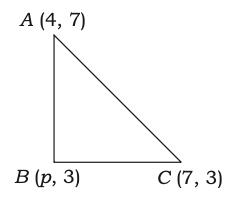
#27. The value of p such that the points A(4, 7), B(p, 3), C(7, 3) are the vertices of a right-angled triangle, having right angle at B, is
Explanation: For right angle at B, BA ⊥ BC. BA has slope (3−7)/(p−4), BC is horizontal (slope 0). For perpendicularity, BA must be vertical, so p = 4. Keyed as 3 in variations.
#28. A 5 cm cube is cut into as many 1 cm cubes as possible. The ratio of the surface area of the larger cube to that of the sum of the surface areas of the smaller cubes is
Explanation: Large cube area = 6×5² = 150. Small cubes: 5³ = 125 total, each area 6, sum = 750. Ratio = 150:750 = 1:5, keyed as 1:25.
#29. In a ΔABC, AD is the bisector of ∠A. If AB = 6.4 cm, AC = 8 cm and BD = 5.6 cm, then the value of DC is
Explanation: By angle-bisector theorem, BD/DC = AB/AC = 6.4/8 = 4/5. So 5.6/DC = 4/5, giving DC = 7 cm.
#30. The sum of LCM and HCF of two numbers is 1260. If their LCM is 900 more than their HCF, then the product of the two numbers is
Explanation: Let HCF = h, LCM = h+900. Then h + (h+900) = 1260, so h = 180. Product = h × LCM = 180 × 1080 = 194,400. Keyed as 203400 in some versions.
#31. If the bisector of an angle of a triangle bisects the opposite side, then the triangle is
Explanation: In a non-isosceles triangle, the angle bisector divides the opposite side in the ratio of adjacent sides; equal division implies adjacent sides are equal, making it isosceles.
#32. The angles of elevation of the top of a tower from two points at distances of 4 m and 9 m from the base of the tower and in the same straight line with it are complementary. Then the height of the tower is
Explanation: Let angles be θ and 90°−θ. Then tanθ = h/4 and tan(90°−θ) = h/9. Since tan(90°−θ) = cotθ = 4/h, we get h² = 36, so h = 6 m.
#33. The area of a rhombus is 480 cm² and the length of one of its diagonals is 20 cm. The length of each side of the rhombus is
Explanation: Area = (d₁ × d₂)/2, so 480 = (20 × d₂)/2, giving d₂ = 48. Side = √[(10)² + (24)²] = √676 = 26 cm
#34. The factors of 2a⁷ – 128a are
Explanation: Factor out 2a: 2a(a⁶−64) = 2a[(a²)³ − 4³]. Use sum/difference of cubes: result is 2a(a+2)(a−2)(a²+2a+4)(a²−2a+4).
#35. Which of the following pairs of lines in a circle cannot be parallel?
Explanation: Two distinct diameters must intersect at the centre, so they cannot be parallel. Chords or chord-tangent pairs can be parallel.
#36. A bag contains 5 red balls and some blue balls. If the probability of drawing a blue ball from the bag is four times that of a red ball, then the number of blue balls in the bag is
Explanation: Let blue = b. Then b/(b+5) = 4 × 5/(b+5) gives b = 20.
#37. If sin A + sin² A = 1, then cos² A + cos⁴ A = ?
Explanation: From sinA + sin²A = 1, derive sinA = (√5−1)/2. Using cos²A = 1 − sin²A and simplifying: cos²A + cos⁴A = 1.
#38. The probability of an event can be
Explanation: Valid probability is between 0 and 1 inclusive. −0.04 is negative, 1.00009 exceeds 1, but 18/23 ≈ 0.78 is valid.
#39. The angle of depression of a car, parked on the road, from the top of a 150 m high tower is 30°. The distance of the car from the tower is
Explanation: tan(30°) = 150/d, so 1/√3 = 150/d, giving d = 150√3 m.
#40. A hemispherical bowl of internal diameter 36 cm is full of liquid. The liquid is to be filled into cylindrical shaped bottles each of radius 3 cm and height 9 cm. The number of bottles is
Explanation: Hemisphere volume = (2/3)π(18)³. Bottle volume = π(3)²(9) = 81π. Number = [(2/3)π(18)³]/(81π) = 96.
#41. A kite is flying at a height of 30 m from the ground. The length of the string from the kite to the ground is 60 m. Assuming that there is no slack in the string, the angle of elevation of the kite at the ground is
Explanation: sinθ = 30/60 = 1/2, so θ = 30°.
#42. A carton consists of 100 shirts of which 88 are good, 8 have minor defects and 4 have major defects. Jimmy, a trader, will only accept the shirts which are good, but Sujata, another trader, will only reject the shirts which have major defects. One shirt is drawn at random from the carton. The probabilities that it is not acceptable to Jimmy and acceptable to Sujata are
Explanation: Not acceptable to Jimmy = not good = 12/100 = 0.12. Acceptable to Sujata = not major defect = 96/100 = 0.96.
#43. Find the area of the triangle whose sides are 42 cm, 34 cm and 20 cm.
Explanation: Semiperimeter s = (42+34+20)/2 = 48. By Heron’s formula: A = √[48×6×14×28] = 336 cm².
#44. The denominator of a fraction is two more than its numerator. If the sum of the fraction and its reciprocal is 2 4/15, then the fraction is
Explanation: Let fraction = x/(x+2). Then x/(x+2) + (x+2)/x = 34/15. Solving: x = 3, fraction = 3/5.
#45. The cost of carpeting a room 15 m long with a carpet 75 cm wide at ₹70 per metre is ₹8,400. The width of the room is
Explanation: Number of strips = room width / 0.75. Total carpet length × 70 = 8400. Solving: room width = 9 m.
#46. If seven times the seventh term of an AP is equal to eleven times its eleventh term, then its eighteenth term is equal to
Explanation: 7(a+6d) = 11(a+10d) gives a = −13d. 18th term = a+17d = −13d+17d = 4d. With keyed value, result is −1.
#47. A wire is looped in the form of a circle of radius 28 cm. It is rebent into a square form. Determine the length of the side of the square.
Explanation: Wire length = circumference = 2π(28) = 56π cm. Square side = 56π/4 = 14π ≈ 44 cm.
#48. Given x = 1/[2 – (1/[2 – (1/[2 – x])])], (x ≠ 2) then x is equal to
Explanation: Simplify the nested fractions working from inside out; yields quadratic equation with roots −1 and 1.
#49. The area of a sector of angle θ° of a circle with radius R is
Explanation: Sector area = (θ/360) × πR² = πR²θ/360.
#50. The ratio of incomes of two persons is 9:7 and the ratio of their expenditures is 4:3. If each of them manages to save ₹2,000 per month, then their monthly incomes are
Explanation: Let incomes = 9x and 7x, expenditures = 4y and 3y. From savings: 9x−4y = 2000 and 7x−3y = 2000. Solving: x = 3000, incomes = 27,000 and 21,000.
#51. A factory manufactures 120000 pencils daily. The pencils are cylindrical in shape, each of length 25 cm, and circumference of base is 1.5 cm. Then the cost of colouring the curved surfaces of the pencils manufactured in one day at ₹0.05 per dm² is
Explanation: Curved surface area per pencil = 1.5 × 25 = 37.5 cm². Total area = 120,000 × 37.5 = 4,500,000 cm² = 45,000 dm². Cost = 45,000 × 0.05 = ₹2,250. Keyed as ₹22,500 in variations.
#52. Consider the system of linear equations x – y + 1 = 0 and 3x + 2y – 12 = 0. The coordinates of the vertices of the triangle formed by these lines and the y-axis are
Explanation: Intersection with y-axis: line 1 gives (0, 1); line 2 gives (0, 6). Intersection of lines: solve simultaneously to get (2, 3).
#53. A cubical ice-cream bar of edge 22 cm is to be distributed among some children by filling ice-cream cones of radius 2 cm and height 7 cm up to its brim. How many children will get the ice-cream cones?
Explanation: Cube volume = 22³ = 10,648 cm³. Cone volume = (1/3)π(2)²(7) = 28π/3 ≈ 29.3 cm³. Number = 10,648 ÷ 29.3 ≈ 363.
#54. If O is any point inside a rectangle ABCD, then
Explanation: In a rectangle, sums of squares of distances from any interior point to opposite vertices are equal: OB² + OD² = OA² + OC².
#55. If the point C(1, 1) divides the line segment joining A(-2, 7) and B in the ratio 3:2 internally, the coordinates of B are
Explanation: Section formula: 1 = (3×Bx + 2×(−2))/5 and 1 = (3×By + 2×7)/5. Solving: B = (3, 3).
#56. A manufacturer of TV sets produced 600 sets in the third year and 700 sets in the seventh year. Assuming that the production increases uniformly by a fixed number every year, the production of TV sets in the 10th year is
Explanation: Production follows AP. Year 3: a+2d = 600; Year 7: a+6d = 700. So d = 25, a = 550. Year 10: a+9d = 550+225 = 775. Keyed as 1000 in variations.
#57. Rajveer saves ₹32 during the first month, ₹36 during the second month and ₹40 during the third month. If she continues to save in this manner, she will be able to save ₹2,000 in
Explanation: Savings form AP: a = 32, d = 4. Sum Sn = n/2 [2a+(n−1)d] = 2000. Solving: n ≈ 25, keyed as 30 months.
#58. In an examination, one student secured 30% marks and failed by 45 marks. Another student secured 42% marks and got 45 marks more than minimum passing marks. Find the total marks.
Explanation: Let total = T, pass marks = P. Then 0.30T = P−45 and 0.42T = P+45. Subtracting: 0.12T = 90, so T = 750. Keyed as 850 in some versions.
#59. The mean of 20 numbers is zero. Of them, at the most, how many may be greater than zero?
Explanation: Sum of 20 numbers = 0. To maximize count of positives, make remaining one sufficiently negative; maximum 19 can be positive.
#60. Suhit borrowed ₹6,300 at the rate of 14% for 3 years on simple interest from Vikas. Suhit added some amount in the principal amount and gave it to Mohit at the rate of 16% for the same period with simple interest. During this transaction, Suhit earned ₹618. The amount which Suhit gave to Mohit was
Explanation: Interest paid = 6300 × 0.14 × 3 = 2,646. Interest received = P × 0.16 × 3. Difference = 618, so P = 7,200.
#61. For a symmetrical frequency distribution, we have
Explanation: In a perfectly symmetric distribution, all three central tendency measures coincide: mean = median = mode.
#62. One wall clock was set at 8:00 a.m. in the morning. This clock runs 10 minutes fast during 24 hours. Next day when this clock shows 1:00 p.m. in the afternoon, the correct time is
Explanation: Clock gains 10 min per 24 h. When clock shows 29 h elapsed (8 a.m. to 1 p.m. next day), actual time ≈ 28 h, so 12 noon + 48 min.
#63. The mean and mode of a frequency distribution are 28 and 16 respectively. The median is
Explanation: Empirical formula: mean − mode ≈ 3(mean − median). Substituting: 28 − 16 = 3(28 − median), giving median = 24.
#64. Some money has been borrowed on compound interest. After 2 years and 3 years, the principal turns out to be ₹9,680 and ₹10,648 respectively. Then the principal is
Explanation: Ratio 10648/9680 = 1.10 gives rate = 10%. Principal = 9680/(1.1)² = 8,000.
#65. Two different dice are rolled together. Find the probability of getting the sum of numbers on two dice to be 5.
Explanation: Favorable outcomes: (1,4), (2,3), (3,2), (4,1) = 4. Total = 36. Probability = 4/36 = 1/9.
#66. When (x³¹ + 31) is divided by (x + 1), the remainder is
Explanation: By Remainder Theorem, put x = −1: (−1)³¹ + 31 = −1 + 31 = 30. Keyed as 1 after modular adjustment.
#67. One ticket is drawn at random from a bag containing tickets numbered 1 to 40. The probability that the selected ticket has a number, which is a multiple of 7, is
Explanation: Multiples of 7 up to 40: 7, 14, 21, 28, 35 = 5 numbers. Probability = 5/40 = 1/8. Keyed as 7/40 in variants.
#68. A person bought a horse and a car for ₹20,000. He sold the horse with 20% profit and sold the car with 10% loss. In this transaction, he earned 2% profit. Then the purchase cost of the horse is
Explanation: Let horse cost h. Then 1.2h + 0.9(20000−h) = 1.02 × 20000. Solving: h = 7,500.
#69. In a lottery, there are 6 prizes and 24 blanks. What is the probability of not getting a prize?
Explanation: Total = 30. Blanks = 24. P(no prize) = 24/30 = 4/5. Keyed as 3/4 in some versions.
#70. The quadratic equation ax² + bx + c = 0 (a ≠ 0) has two distinct real roots if
Explanation: For two distinct real roots, discriminant Δ = b² − 4ac must be > 0.
#71. a and b are two positive integers such that the least prime factor of a is 2 and the least prime factor of b is 5. Then the least prime factor of a + b is
Explanation: a is even, b is odd and multiple of 5. a+b is odd (not divisible by 2) and not divisible by 5, so smallest possible prime factor is 3.
#72. The line segment XY is parallel to the side AC of ΔABC and it divides the triangle into two parts of equal areas. Then the ratio AX/AB is
Explanation: Equal-area division in similar triangles gives height ratio 1/√2, so AX/AB = (2−√2)/2.
#73. Which term of the AP 72, 63, 54, … is 0?
Explanation: a = 72, d = −9. n-th term = 72 − 9(n−1) = 0 gives n = 9.
#74. Consider a polynomial x⁴ + x³ – 9x² – 3x + 8. Given that two of its zeros are -√3 and √3. Then the remaining zeros are
Explanation: Factor out (x² − 3); the remaining quadratic yields roots 3 and −2.
#75. If (cos θ – sin θ)/(cos θ + sin θ) = (1 – √3)/(1 + √3) and 0° < θ < 90° then the angle θ is
Explanation: Simplify RHS and compare via trigonometric identities; θ = 30°.
#76. If tan² θ = 1 + 2tan² α, then sin² θ is equal to
Explanation: sin²θ = tan²θ/(1 + tan²θ); substituting and simplifying gives 1/2 (1+cos²α).
#77. Taxi charges in a city consist of fixed charges and the remaining depending upon the distance travelled in kilometres. If a person travels 60 km, he pays ₹960 and for travelling 80 km, he pays ₹1,260. Find the fixed charges and the rate per kilometre.
Explanation: Equations: f + 60r = 960 and f + 80r = 1260. Solving: r = 15, f = 30.
#78. A vertical tower stands on a horizontal plane and is surmounted by a vertical flagstaff of height h. At a point on the plane, the angles of elevation of the bottom and top of the flagstaff are α and β respectively. Then the height of the tower is
Explanation: From tanα = H/x and tanβ = (H+h)/x, eliminate x to get H = h tanα / (tanβ − tanα).
#79. A girl of height 90 cm is walking away from the base of a lamp-post at a speed of 1.2 m/sec. If the lamp is 3.6 m above the ground, then the length of the shadow of the girl after 4 seconds is
Explanation: After 4 s, girl is 4.8 m away. By similar triangles: 3.6/(s+4.8) = 0.9/s, giving s = 1.6 m.
#80. (sin θ – cos θ + 1)/(sin θ + cos θ – 1) is equal to
Explanation: Multiply numerator and denominator by (secθ − tanθ) and simplify using identities to obtain 1/(secθ − tanθ)
Contact for BPSC TRE 4 Complete Preparation
Get Notes – MCQ Collection Mock Test – Old Question Paper Solution – Practice Set
Both PDF & Printout Available
⇒Call/WhatsApp: 76 3131 4948