
BPSC TRE Previous Question Paper Quiz
विद्यालय अध्यापक परीक्षा के पूछे गए प्रश्न
For Class (1-5), (6-8), (9-10), (11-12)
Results


#1. A rocket, set for vertical firing, weighs 50 kg and contains 450 kg of fuel. It can have a maximum exhaust velocity of 5 km/sec. What should be its minimum rate of fuel consumption to just lift it off the launching pad?
To just lift off, the upward thrust must equal the rocket’s weight.
-
Total mass = 50 kg + 450 kg = 500 kg.
-
Weight, W = mg = 500 × 9.8 = 4900 N.
-
Thrust, F = v_exhaust × (dm/dt) = 5000 × (dm/dt).
-
For lift-off: 5000 × (dm/dt) = 4900.
-
Therefore, dm/dt = 4900 / 5000 = 0.98 kg/sec.
#2. Consider circular orbits in a central force potential V(r) = –k/rⁿ, where k > 0 and 0 < n < 2. If the time period of a circular orbit of radius R is T₁ and that of radius 2R is T₂, then T₂/T₁ is
For a central force, F ∝ 1/r^(n 1). For a circular orbit, centripetal force equals central force: mv²/r ∝ 1/r^(n 1), so v ∝ 1/r^(n/2). Time period T = 2πr/v ∝ r^(1 n/2). Thus, T₂/T₁ = (2R/R)^(1 n/2) = 2^((n 2)/2). This expression is not listed in the options.
#3. What is the ratio of total kinetic energies in laboratory system (T_L) and centre of mass system (T_C) in the scattering with projectile of mass m₁ and target of mass m₂?
The total kinetic energy in the lab frame is the sum of the kinetic energy of the center of mass and the kinetic energy in the CM frame: T_L = T_CM T_C. The ratio T_L / T_CM is (m₁ m₂)/m₁. The question likely refers to this ratio, as T_C is the energy available for the reaction.
#4. In the analysis of flow velocity of a fluid for a fixed instant of time, a space curve is drawn so that it is tangent everywhere to the velocity vector. Then this curve is usually known as
A streamline is defined as a curve that is everywhere tangent to the velocity vector of the flow at a specific instant in time.
#5. Two boxes A and B contain equal number of molecules of the same gas. If the volumes are V_A and V_B, and l_A and l_B denote respective mean free paths, then
The mean free path l is inversely proportional to the number density n (n = N/V). Since N is the same for both boxes, l ∝ V. Therefore, l/V is a constant, so l_A/V_A = l_B/V_B.
#6. Which of the following is not the characteristic of Planck’s black-body radiation distribution?
According to Wien’s displacement law, the wavelength of peak emission is inversely proportional to temperature (λ_max ∝ 1/T). Therefore, as temperature increases, the peak shifts towards lower, not higher, wavelengths.
#7. In an interference pattern produced by two identical slits, the intensity at the site of maxima is I. If either of the slits is closed, the intensity at the same spot is I₀. What is the relation between I and I₀?
With one slit, amplitude = a, so intensity I₀ ∝ a².
With two slits at maxima, amplitudes add: A = a + a = 2a, so intensity I ∝ (2a)² = 4a².
Thus, I = 4I₀.
#8. A light of 600 nm wavelength is incident on a single slit. The first minimum of the diffraction pattern is obtained at a distance of 4 mm from the centre. The distance between the screen and the slit is 2 m. What is the width of the slit?
For the first minimum in single-slit diffraction: a sinθ = λ.
For small angles, sinθ ≈ y/D, where y = 4 mm = 0.004 m, D = 2 m.
So, a (y/D) = λ → a = λD / y = (600 × 10⁻⁹ m × 2 m) / 0.004 m = 3 × 10⁻⁴ m = 0.3 mm.
#9. At what angle of incidence of plane-polarized light with quarter-wave plate, elliptically polarized light becomes circularly polarized?
A quarter-wave plate introduces a π/2 phase difference. For the output to be circularly polarized, the incident plane-polarized light must be oriented at 45° to the optic axis. This ensures equal amplitudes for the ordinary and extraordinary waves, which, when combined with a π/2 phase difference, results in circular polarization.
#10. If a wave is having group velocity of 2×10⁸ m/sec, then what is phase velocity?
For light waves in a medium, the product of group velocity (v_g) and phase velocity (v_p) is c².
v_g × v_p = c² → v_p = c² / v_g = (3 × 10⁸)² / (2 × 10⁸) = 9 × 10¹⁶ / 2 × 10⁸ = 4.5 × 10⁸ m/s.
#11. From the wave equation y(x,t) = 0·5 sin(3x – 64πt/2), the frequency of the wave is
The given equation is y = 0.5 sin(3x – 32π t). Comparing with standard form y = A sin(kx – ωt), we find ω = 32π rad/s.
Frequency f = ω / (2π) = 32π / (2π) = 16 Hz.
Since 16 Hz is not among the options, the correct answer is “None of the above”.
#12. Identify which of the following expressions is not Maxwell’s equation for time-varying fields.
All three given equations are indeed Maxwell’s equations:
-
Ampère-Maxwell law
-
Faraday’s law
-
Gauss’s law for magnetism
Therefore, none of them is “not Maxwell’s equation”.
#13. The voltage induced across a stationary conductor in an external static magnetic field
According to Faraday’s law, voltage is induced only when there is a change in magnetic flux. With a stationary conductor and a static magnetic field, the flux is constant, so the induced voltage is zero.
#14. A wire in the shape of an equilateral triangle with sides of length 1 m sits in a magnetic field of 2 T, pointing to the right. What is the magnitude of the magnetic flux through the triangle?
The magnetic flux Φ = B ⋅ A = BA cosθ, where θ is the angle between the field and the area vector (perpendicular to the plane of the loop). If the magnetic field is parallel to the plane of the loop, then θ = 90° and cosθ = 0, resulting in zero flux. This is a common scenario in such problems.
#15. Which of the following statements is/are true regarding Biot–Savart law? (i) Magnetic field is directly proportional to the length of element. (ii) Biot–Savart law deals with electric field. (iii) Magnetic field is directly proportional to the current through the conductor. Select the correct answer using the codes given below.
The Biot-Savart law is dB = (μ₀/4π) I (dl × r̂)/r².
(i) True: dB ∝ |dl|
(ii) False: It deals with magnetic field, not electric field.
(iii) True: dB ∝ I
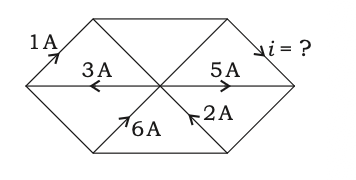
#16. Find the value of the current i in the given circuit.
The 10Ω and 15Ω resistors are in parallel: R_parallel = (10×15)/(10+15) = 150/25 = 6Ω.
This combination is in series with the 4Ω resistor: R_total = 6Ω + 4Ω = 10Ω.
Using Ohm’s law: i = V/R_total = 20V / 10Ω = 2A.
#17. Which of the following statements is not correct about quality factor of a parallel resonance circuit?
In a parallel resonance circuit, the Q-factor provides current magnification, not voltage magnification. Voltage magnification is a characteristic of series resonance circuits.
#18. In a photoelectric experiment, both sodium (work function = 2·3 eV) and tungsten (work function = 4·5 eV) metals are illuminated by an ultraviolet light of same wavelength. If the stopping potential for tungsten is measured to be 1·8 V, then the value of the stopping potential for sodium will be
For tungsten: K_max = eV_s = hν – φ → 1.8 eV = hν – 4.5 eV → hν = 6.3 eV.
For sodium: eV_s = hν – φ = 6.3 eV – 2.3 eV = 4.0 eV.
So, stopping potential for sodium is 4.0 V.
#19. The fine structure of atomic spectral lines arises from
The fine structure in atomic spectra is due to the interaction between the electron’s spin and its orbital motion (spin-orbit coupling).
#20. An atom with proton number 84 and nucleon number 216 decays into a new element. In this process, it emits an alpha particle. What is the structure of the new nucleus after the emission?
An alpha particle is ⁴₂He. In alpha decay:
-
New proton number = 84 – 2 = 82
-
New nucleon number = 216 – 4 = 212
#21. Which of the following reactions is not allowed?
We need to check conservation laws. For Λ + Σ⁺ → n + p + π⁺:
-
Charge: 0 + 1 = 0 + 1 + 1 → conserved (1=1)
-
Baryon number: 1 + 1 = 1 + 1 + 0 → conserved (2=2)
-
Strangeness: -1 + (-1) = 0 + 0 + 0 → not conserved (-2 ≠ 0)
Strangeness is not conserved, so this reaction is not allowed by the strong or electromagnetic interaction.
#22. Donor-type impurities are the materials of
Explanation:
Donor impurities have 5 valence electrons (e.g., phosphorus, arsenic) and belong to group V of the periodic table. When added to silicon (group IV), they provide an extra electron for conduction.
#23. In an n-type semiconductor, the Fermi level lies
Explanation:
In an n-type semiconductor, donor impurities add extra electrons, increasing the electron concentration in the conduction band. This shifts the Fermi level upward, closer to the conduction band.
#24. The maximum efficiency of a half-wave rectifier is
The maximum theoretical efficiency of a half-wave rectifier is (1/π)² × 100% ≈ (0.318)² × 100% ≈ 40.6%.
#25. Consider the following types of modulation: (i) Amplitude modulation (ii) Frequency modulation (iii) Phase modulation (iv) Pulse modulation. Which of the above modulations are used for telecasting TV programs?
In traditional analog TV broadcasting:
-
Video information is transmitted using Amplitude Modulation (AM)
-
Audio information is transmitted using Frequency Modulation (FM)
#26. For every 10 ºC increase in temperature, the reverse saturation current of a p–n junction will be increased by
Explanation:
The reverse saturation current approximately doubles (increases by 2 times) for every 10°C rise in temperature.
#27. The band gap energies for silicon and germanium photodiodes are 1·1 eV and 0·67 eV respectively. Their cut-off wavelengths respectively would be
Explanation:
Cut-off wavelength λ_c = 1240 / E_g (where E_g is in eV and λ_c in nm).
For silicon: λ_c = 1240 / 1.1 ≈ 1127.27 nm
For germanium: λ_c = 1240 / 0.67 ≈ 1850.75 nm
#28. Which method can be employed to produce a high degree of homogeneity in the creation of ZnFe₂O₄ spinel?
Explanation:
The coprecipitation method allows for mixing at the molecular level in solution, resulting in highly homogeneous products like ZnFe₂O₄ spinel.
#29. _____ is a crystalline solid’s basic repetitive structural unit.
Explanation:
The unit cell is the smallest repeating unit that, when repeated in three dimensions, generates the entire crystal lattice.
#30. For all the reactions, what is the nature of the chemical dissociation?
Explanation:
Chemical dissociation can be exothermic (releases heat), endothermic (absorbs heat), or reversible depending on the specific reaction and conditions.
#31. The radius of an atomic nucleus is of the order of
Explanation:
Nuclear radii are typically of the order of 1-10 femtometers (1 fm = 10⁻¹⁵ m = 10⁻¹³ cm).
#32. Atomic orbital is
Explanation:
An atomic orbital is defined as a region in space around the nucleus where there is a high probability (typically 90%) of finding an electron.
#33. In the rate equation, when the concentration of reactants is unity, then the rate is equal to
Explanation:
For a reaction with rate law: rate = k[A]^m[B]^n, when [A] = [B] = 1, then rate = k. So the rate equals the specific rate constant.
#34. In the reaction 2A + B → A₂B, if the concentration of A is doubled and that of B is halved, then the rate of the reaction will
Explanation:
Assuming the rate law is rate = k[A]²[B]:
New rate = k(2[A])²([B]/2) = k(4[A]²)([B]/2) = 2k[A]²[B] = 2 × original rate.
#35. A substance A decomposes by a first-order reaction starting initially with [A]₀ = 2·00 M and after 200 minutes, [A] becomes 0·15 M. For this reaction t₁/₂ is
Explanation:
For first-order kinetics: k = (2.303/t) log([A]₀/[A]) = (2.303/200) log(2.00/0.15) = (2.303/200) log(13.33) ≈ (2.303/200) × 1.125 ≈ 0.01295 min⁻¹.
Half-life t₁/₂ = 0.693/k = 0.693/0.01295 ≈ 53.51 minutes (closest to 53.72 minutes).
#36. Which of the following assertions about the main cell is correct?
Explanation:
A mercury cell is a primary (non-rechargeable) cell. Primary cell reactions cannot be reversed by applying an external potential. Nickel-Cadmium cells are secondary (rechargeable) cells.
#37. A catalyst alters which of the following in a chemical reaction?
A catalyst works by providing an alternative reaction pathway with a lower activation energy. It does not change the thermodynamic parameters (entropy, internal energy, enthalpy) of the reaction.
#38. Photochemistry deals with the study of
Explanation:
Photochemistry is the branch of chemistry concerned with chemical effects caused by absorption of visible or ultraviolet light.
#39. The number of photons that pass through a unit area in a unit time is called
Explanation:
Intensity of light is defined as the number of photons crossing a unit area per unit time, or equivalently, the power per unit area.
#40. The transition without emission of radiation of a molecule from a stable excited state to an unstable excited state that leads to dissociation is
Explanation:
Predissociation occurs when a molecule in a stable excited state makes a radiationless transition to a repulsive (unstable) excited state, leading to dissociation of the molecule.
#41. Which of the following products are obtained when Na2CO3 is added to a solution of copper sulphate?
Explanation:
Sodium carbonate reacts with copper sulphate to form a basic copper carbonate (like CuCO₃·Cu(OH)₂), sodium sulphate, and carbon dioxide. It does not form simple copper carbonate or copper hydroxide as the main product.
#42. The pair that has similar atomic radii is
Explanation:
Due to lanthanoid contraction, the expected increase in atomic radius from the 4d to the 5d series elements is canceled out. This results in elements in the second and third transition series (e.g., Zr and Hf, Nb and Ta, Mo and W) having nearly identical atomic radii.
#43. According to the IUPAC nomenclature, sodium nitroprusside dihydrate is named as
Explanation:
The nitroprusside ion is [Fe(CN)₅(NO)]²⁻. In this complex, the iron is in the +2 oxidation state (ferrate(II)), it is coordinated by five cyanide (cyano) ligands and one nitrosyl (nitrosyl) ligand.
#44. A substance X is used in whitewashing and is obtained by heating limestone in the absence of air. Identify X.
Explanation:
Heating limestone (CaCO₃) in the absence of air is calcination: CaCO₃(s) → CaO(s) + CO₂(g). The product, calcium oxide (CaO or quicklime), is slaked with water to form Ca(OH)₂ (slaked lime), which is the actual compound used in whitewashing.
#45. A dilute ferrous sulphate solution is gradually added to the beaker containing acidified permanganate solution. The light purple colour of the solution fades and finally disappears. Which of the following is the correct explanation for the observation?
Explanation:
In acidified medium, KMnO₄ (purple) is a strong oxidizing agent. It oxidizes Fe²⁺ ions from FeSO₄ to Fe³⁺ and is itself reduced to colorless Mn²⁺ ions. This decolorization is a characteristic test for oxidizing agents like permanganate.
#46. How many structural isomers are possible if one hydrogen in diphenylmethane is replaced by chlorine?
Explanation:
Diphenylmethane (C₆H₅–CH₂–C₆H₅) has a -CH₂- bridge. The four non-equivalent positions for chlorine substitution are: two positions on one ring (ortho and meta/para to the bridge, considering symmetry), and the two positions on the other ring (which are equivalent to the first due to symmetry), and the bridge carbon itself. A detailed count shows 4 distinct monochloro structural isomers.
#47. Which among the following statements is/are true? Exposure of silver chloride to sunlight for a long duration turns it grey due to the (i) formation of silver metal (ii) formation of silver ions (iii) chlorine gas escaping from the surface of silver chloride (iv) decomposition of silver chloride. Select the correct answer using the codes given below.
Explanation:
The reaction is: 2AgCl(s) → 2Ag(s) + Cl₂(g). The grey color is due to the formation of fine silver metal (i). Chlorine gas is produced and escapes (iii). This is a decomposition reaction (iv), but the specific products listed in (i) and (iii) are the direct cause of the observation.
#48. Which of the following is a branched polymer?
Explanation:
While HDPE is linear, Low-Density Polyethylene (LDPE) is a common example of a branched chain polymer. Polyvinyl Chloride (PVC) can also have branched structures depending on the polymerization conditions. Teflon (PTFE) is generally linear. Since at least one common form of polyethylene is branched, the correct choice is “More than one of the above”.
#49. Which of the following monomers form biodegradable polymers?
Explanation:
Polymers like Polylactic Acid (PLA) and Polyglycolic Acid (PGA), derived from lactic acid and glycolic acid respectively, are well-known biodegradable polymers used in medical sutures and packaging. Styrene, acrylonitrile, and vinyl chloride form non-biodegradable plastics like polystyrene, ABS, and PVC.
#50. The correct order of increasing nucleophilicity is
Explanation:
In polar protic solvents (like water), nucleophilicity increases down a group in the periodic table due to poorer solvation of larger ions. Thus, the order for halides is F⁻ < Cl⁻ < Br⁻ < I⁻. Acetate (CH₃COO⁻) is a very poor nucleophile because the negative charge is resonance-stabilized. Therefore, CH₃COO⁻ is the weakest nucleophile among the given ions.
#51. Select the correct statement from the following options.
Explanation:
Carbocation stability increases with the number of alkyl groups attached to the positively charged carbon due to the inductive electron-donating effect and hyperconjugation of the alkyl groups. Thus, tertiary (3°) carbocations are the most stable, followed by secondary (2°), then primary (1°), and methyl (CH₃⁺) is the least stable.
#52. A carbonyl group will cause a sharp dip at about _____ cm–1.
Explanation:
The carbonyl (C=O) stretching vibration gives a strong, sharp peak in the infrared (IR) spectrum around 1700 cm⁻¹ (typically between 1650-1750 cm⁻¹ depending on the specific compound).
#53. Which is the best suited method for the separation of para- and ortho-nitrophenols from 1:1 mixture?
Explanation:
ortho-Nitrophenol has intramolecular hydrogen bonding, which makes it more volatile. para-Nitrophenol has intermolecular hydrogen bonding, making it less volatile. Steam distillation selectively vaporizes the more volatile ortho-isomer, allowing for their separation
#54. Find the compound which undergoes nucleophilic substitution reaction exclusively by an SN1 mechanism.
Explanation:
tert-Butyl chloride ((CH₃)₃C-Cl) forms a stable tertiary carbocation. This high stability favors the two-step SN1 mechanism. Primary alkyl halides like n-butyl chloride favor SN2, and secondary alkyl halides like sec-butyl chloride can undergo both SN1 and SN2 depending on conditions.
#55. The majority of phytophagous nematodes are
Explanation:
Phytophagous (plant-eating) nematodes, such as root-knot nematodes (Meloidogyne), are predominantly parasites of plant roots, where they cause galls and other damage.
#56. One of the purposes of secondary treatment of wastewater and sewage is
Explanation:
Secondary treatment uses aerobic microorganisms to biologically degrade organic matter in wastewater. This process significantly reduces the Biochemical Oxygen Demand (BOD), which is a measure of the amount of oxygen consumed by microorganisms while decomposing organic waste.
#57. Most bacteria that cause plant diseases are members of the group of
Explanation:
The majority of economically important plant pathogenic bacteria, such as those in the genera Pseudomonas, Xanthomonas, and Erwinia, are rod-shaped (bacilli) and Gram-negative.
#58. Nutritionally Albugo is
Explanation:
Albugo (e.g., Albugo candida, which causes white rust in plants) is an obligate parasite, meaning it can only grow and reproduce on living host tissue.
#59. Which of the following is incorrect statement?
Explanation:
The Compositae (or Asteraceae) family is characterized by having many small flowers aggregated into a composite head (inflorescence that looks like a single flower), not large individual flowers and seeds.
#60. One of the major Basmati rice-producing States in our country is
Explanation:
Uttar Pradesh, along with Punjab and Haryana, is a major producer of Basmati rice in India. Kerala and Andhra Pradesh are not traditionally known for Basmati cultivation.
#61. What is Somaclone?
Explanation:
A somaclone is a plant generated from tissue culture, particularly from somatic cells. While it is genetically identical (a clone) to the original plant, the term specifically refers to the plants that are regenerated and are morphologically similar, though somaclonal variation can sometimes occur.
#62. The functional unit of synthesis of protein is
Explanation:
A polysome (or polyribosome) is a complex of an mRNA molecule and two or more ribosomes that actively translate the mRNA into a polypeptide chain. It is the functional unit for the simultaneous synthesis of multiple copies of a protein.
#63. Active transport takes place
Explanation:
Active transport moves molecules or ions across a membrane against their concentration gradient (from low to high concentration). This process requires energy, typically in the form of ATP.
#64. Tropical evergreen forests are found in which of the following States of India?
Explanation:
Tropical evergreen forests in India are found in areas with very high rainfall, such as the Western Ghats, parts of the Northeast (including Assam), and the Andaman and Nicobar Islands. Madhya Pradesh has predominantly deciduous forests.
#65. Ozone hole refers to
Explanation:
The term “ozone hole” refers to a severe thinning of the ozone layer in a particular area, specifically a large and rapid decrease in the total ozone column. It is not a literal hole but a region of exceptionally depleted ozone.
#66. Groundnut oil is obtained from
Explanation:
Groundnut oil is extracted from the seeds of Arachis hypogaea, the peanut plant. Brassica juncea is mustard, and Artabotrys odoratissimus is a flowering plant not used for oil.
#67. The component of food that does not provide any nutrient to our body and yet is essential in our food is
Explanation:
Roughage, or dietary fiber, is indigestible by humans and does not provide energy or nutrients in the conventional sense. However, it is essential for adding bulk to feces and facilitating bowel movements.
#68. Plasma membrane is built up of
Explanation:
The plasma membrane is primarily composed of a phospholipid bilayer with proteins embedded in it (fluid mosaic model). Carbohydrates are also present, attached to lipids (glycolipids) or proteins (glycoproteins), on the outer surface.
#69. Mendel’s principle of inheritance is based on
Explanation:
Gregor Mendel formulated his laws of inheritance by conducting cross-pollination (sexual reproduction) experiments on pea plants and observing the inheritance of traits from one generation to the next.
#70. When there is a decrease in the concentration of oxygen in the blood, the rate of breathing
Explanation:
A decrease in blood oxygen (hypoxemia) is detected by chemoreceptors, primarily in the carotid and aortic bodies. They send signals to the respiratory center in the medulla oblongata, which increases the breathing rate to take in more oxygen.
#71. In human body, which one of the following hormones regulates blood calcium and phosphate?
Explanation:
Parathyroid hormone (PTH) increases blood calcium levels by stimulating bone resorption, increasing calcium reabsorption in the kidneys, and promoting vitamin D activation (which increases intestinal calcium absorption). It decreases blood phosphate levels.
#72. Quick response towards stress is done by
Explanation:
Epinephrine (adrenaline) is released rapidly by the adrenal medulla in response to stress (the “fight-or-flight” response). Corticosteroids from the adrenal cortex are involved in the longer-term stress response.
#73. Cimex hemipterus parasitizes on
Explanation:
Cimex hemipterus, commonly known as the tropical bed bug, is an ectoparasite that feeds on human blood.
#74. Which of the following is a human ‘blood fluke’?
Explanation:
Schistosoma species are trematode worms (flukes) that live in the blood vessels of their human hosts, causing the disease schistosomiasis. Enterobius is a pinworm (nematode), and Wuchereria is a filarial worm (nematode) that causes elephantiasis.
#75. Which of the following is an embryonic respiratory organ in chick?
Explanation:
In the chick embryo, the allantois functions as a respiratory organ. It fuses with the chorion to form the chorioallantoic membrane, which lies close to the eggshell and facilitates gas exchange.
#76. Which of the following is the correct comparison between a young and an aged person?
Explanation:
With aging, arteries lose elasticity, and the heart muscle may undergo hypertrophy (thickening) in response to increased pressure. Stress-related fat deposition can also occur in adulthood. The question is poorly phrased, but multiple options describe age-related changes.
#77. The study of human improvement by selective breeding is called
Explanation:
Eugenics is the practice or advocacy of improving the human species by selectively mating people with specific desirable hereditary traits.
#78. In some animal groups, the body is found divided into compartments with at least some organs serially repeated. This feature is named as
Explanation:
Metamerism is the phenomenon of having a linear series of body segments (metameres) fundamentally similar in structure, with at least some organs (e.g., muscles, nerves, excretory organs) repeated in each segment. This is seen in annelids, arthropods, and chordates
#79. Which type of larva is found in majority of Crustacea?
Explanation:
The nauplius is a characteristic larval stage of most crustaceans. It is a free-swimming larva with three pairs of appendages and a single median eye.
#80. According to Oparin, which of the following was not present in the primitive atmosphere of the Earth?
Contact for BPSC TRE 4 Complete Preparation
Get Notes – MCQ Collection Mock Test – Old Question Paper Solution – Practice Set
Both PDF & Printout Available
⇒Call/WhatsApp: 76 3131 4948